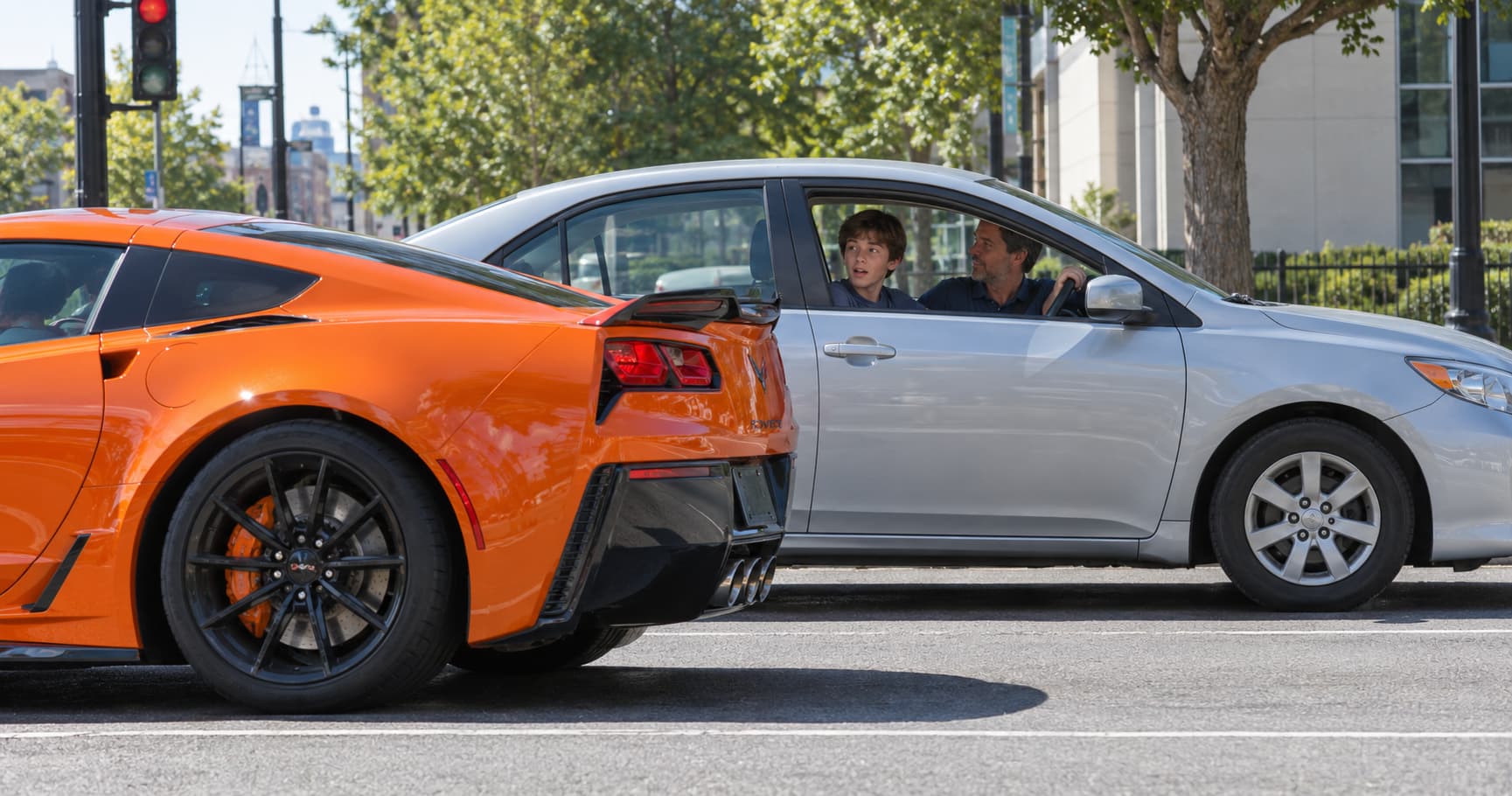
Distraction behind the wheel has one definition: something takes your teen’s attention off driving. The form it arrives in doesn’t change what it does.
A text message does it. So does a shiny, loud Corvette pulling up alongside at a light. So does reaching down to change the song, a passenger telling a story, a street interesting enough to keep looking at, or a thought about something that happened at school. Different triggers, same result — for a few seconds, driving stops getting your teen’s full attention.
That’s why it’s one skill rather than a list of rules. Distraction control is your teen’s ability to hold their attention on the driving task, and to bring it back fast when something pulls it away. The Drive Readiness Score™ defines it as four things: whether your teen avoids phone use, how long their attention leaves the road, whether they make unnecessary adjustments while moving, and whether they stay mentally engaged throughout the drive.
All four are visible from where you’re sitting. That’s the foundation of this skill — you don’t have to guess whether your teen is focused, and you don’t have to wait for a near-miss to find out.
What the Research Says About Teen Distraction
The clearest picture of teen distraction doesn’t come from surveys or police reports. It comes from cameras.
The AAA Foundation for Traffic Safety ran a naturalistic driving study that put in-vehicle cameras in teens’ cars and recorded what drivers were actually doing in the seconds before a crash. The driver was distracted or engaged in some non-driving activity in 58% of moderate-to-severe teen crashes. In road-departure crashes it was 89%. In rear-end crashes, 76%.
That 58% is roughly four times higher than what police reports capture — drivers rarely volunteer that they were distracted, and an officer arriving afterward often can’t tell.
The pattern holds elsewhere. CHOP’s analysis of national crash-causation data names distraction as one of three “critical errors” — alongside scanning failures and speed for conditions — that together account for nearly half of all serious teen crashes. NHTSA’s most recent data shows young drivers ages 15–20 have the largest proportion of distracted drivers in fatal crashes of any age group.
In a study of more than 600 parent-teen pairs, Hartos and colleagues found that parents reported their teens engaging in fewer risky driving behaviors than the teens reported about themselves — a gap wide enough that parents were deciding about independence on incomplete information.
These teen driving statistics point to something more specific than “teens get distracted.” They point to two sources, and the second surprises most parents.
The Two Distractions That Matter Most
Phones. A phone is uniquely dangerous because it takes all three kinds of attention at once — visual (eyes off the road), manual (hands off the wheel), and cognitive (mind off driving). Most secondary tasks take one or two. Texting takes all three.
NHTSA frames the cost in a way that’s hard to forget: taking your eyes off the road for five seconds at 55 mph means traveling roughly the length of a football field without looking. And it’s common. In the CDC’s national survey of high school students, 39% of those who had driven in the previous month said they had texted or emailed behind the wheel on at least one of those days.
Passengers. This is the distraction unique to teens, and the one parents underweight. CHOP’s research found that among teen drivers distracted by something inside the vehicle just before a crash, 71% of males and 47% of females were distracted specifically by the actions of their passengers. Not the radio, not a phone — the people in the car.
Peer passengers also raise the risk of risky driving generally, and the risk of a fatal crash climbs with each additional teen passenger. This is why passenger limits are standard in Graduated Driver Licensing programs — and states with comprehensive GDL rules report up to roughly 40% lower than states with the weakest laws in fatal crashes among 16-year-olds.
A phone can go in the glove box. A carload of friends is harder, which is why it needs practice, not a one-time rule.
Why Teens Struggle to Stay Focused
For a new driver, driving is still the foreground task. Steering, braking, mirrors, staying centered in the lane — all of it takes deliberate attention. So a glance at the navigation screen — the kind that costs you nothing after twenty years of driving — takes a much larger share of what they have available. Same action, different price.
Friends change the math again. Adolescence brings a heightened sensitivity to peers, and the presence of friends activates the brain’s reward circuitry in a way an adult passenger simply doesn’t. Your teen driving with you is not the same driver as your teen driving with three classmates, and the difference isn’t effort or attitude. At that age, the back seat is genuinely the most interesting thing in the car.
Which is why the goal isn’t a teen who never gets pulled away. It’s a teen who notices quickly and comes back — and who has fewer things pulling at them to begin with.
How to Practice Distraction Control on Your Next Drive
Two things to build here: a faster return when attention wanders, and fewer things pulling at it in the first place. Every habit below does one or the other.
Coach the return, not the look. Your teen is going to look at the loud Corvette. So do you. The skill isn’t never looking — it’s looking briefly and coming back without being told. When their head follows something, give them two words instead of a lecture: “Eyes back.” After a few drives the reset starts happening before you say it, which is the entire goal.
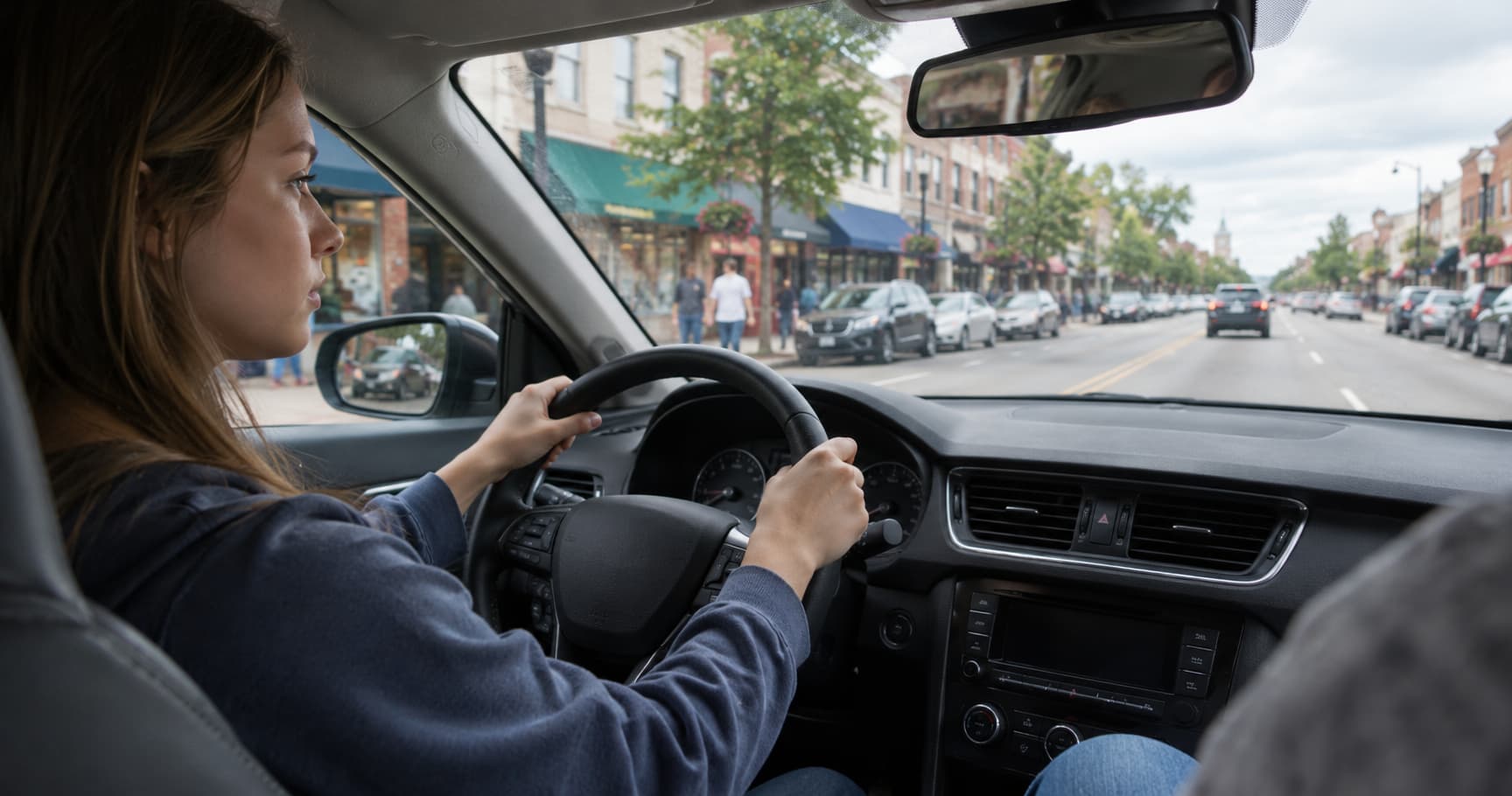
Drive where there’s something to look at. A quiet, familiar route doesn’t test this skill at all. Plan supervised drives down a main street with storefronts, through a neighborhood your teen finds interesting, past a construction site — somewhere with genuine pull. Every interesting thing they pass with their eyes still on the road is one repetition of the skill you’re building.
Set the phone up so it can’t ask for attention. “Put it away” isn’t enough on its own, because a phone buzzing in a bag still pulls. Turn on the driving mode built into the phone — iPhone’s Driving Focus, Android’s Driving Mode — so texts auto-reply and notifications hold until the drive is over. Then silence it properly: sound off and vibration off, because a vibration is still a request. Then it goes out of reach, in the glove box or a bag on the back seat floor.
Make the rest of the setup part of the same ritual. Before the car moves, every time: seat and mirrors set, navigation entered, playlist picked, climate adjusted, and the drive started in Drivvy. Here’s why. Your teen picks the moment to set the map. They don’t pick the moment a child steps into the road. Parked, setting it costs nothing. Moving, it costs whatever they miss while looking down. Say the rule out loud until your teen says it first: anything that needs hands happens before the car moves.
Run passenger drives on purpose. Bring a sibling or a friend along so your teen practices driving while someone talks to them. Let the conversation happen, then discuss what it cost: what they missed, where the speed drifted, whether they turned their head to answer. Most families avoid this drive. It’s the most useful one you can plan for this skill.
Give your teen something to say. Most distraction in a teen’s car is social, and a teen who hasn’t thought about it will simply go along with it — a friend holding out a phone to show them something, three people talking at once, someone asking them to send a reply. Refusing in the moment is harder than it sounds at sixteen. So settle the lines in advance and have your teen say them out loud once, in the driveway: “I’ll look when we stop.” “Read it to me.” “Quiet, I need this turn.” It feels ridiculous for about ten seconds. A sentence they’ve already said is far easier to reach for than one they have to invent at an intersection.
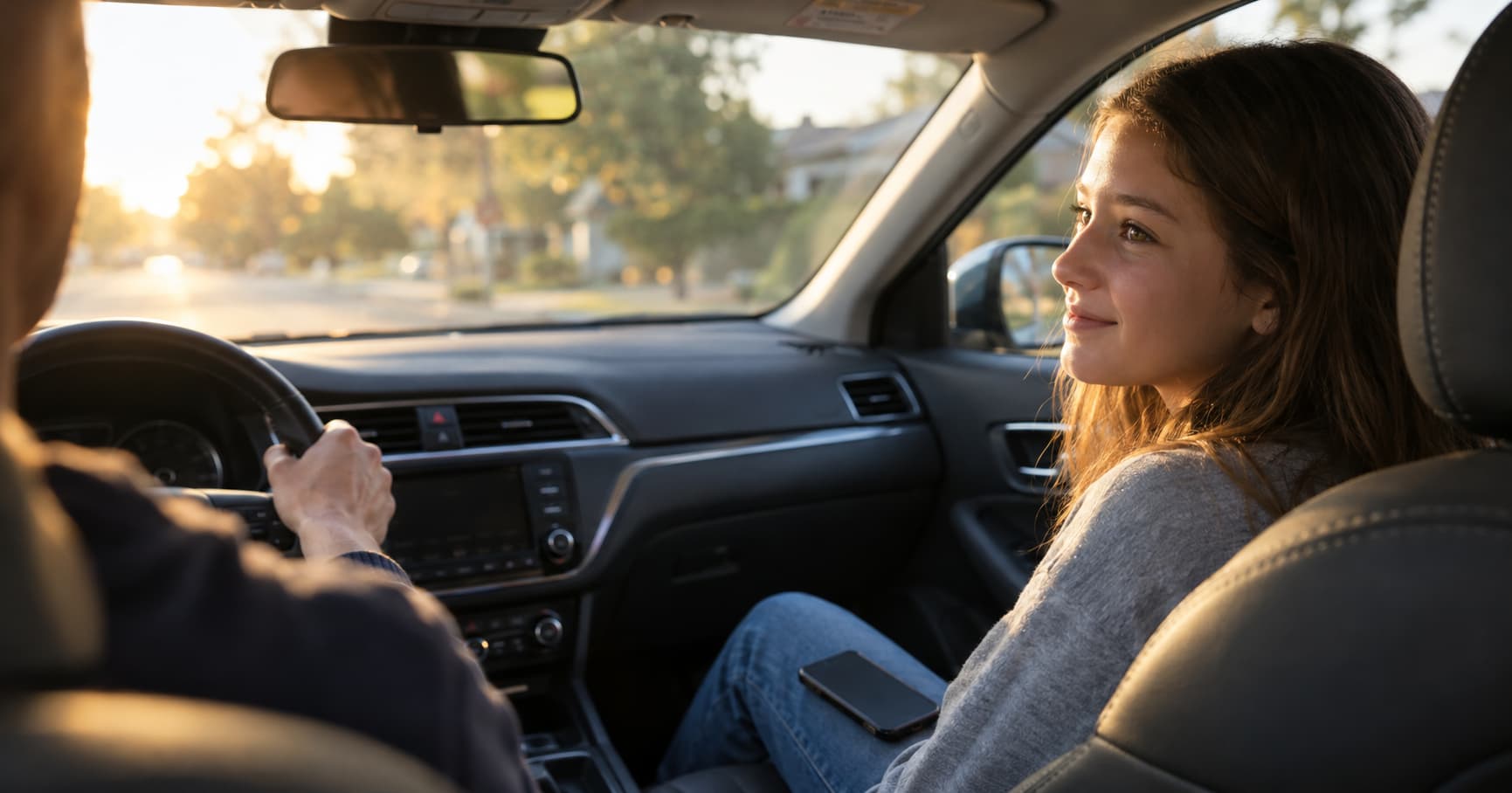
Model it, with no exceptions. Teens tend to drive the way they’ve watched someone drive for sixteen years, and you’re the one they’ve watched. That makes this the cheapest coaching available and the easiest to undo. Check a text at a red light during a supervised drive and your teen now has two rules — the stated one and the demonstrated one — and they will believe the demonstrated one. It runs the other way too: your phone away while you drive them, your navigation set before you pull out, your eyes back on the road after the Corvette. A ritual that’s a family rule rather than a teen rule is one they’re far less likely to drop the day they drive alone.
What Good Distraction Control Actually Looks Like
The four things the score asks about are all easy to watch, once you know that’s what you’re watching.
The phone is the simplest: set up and away before the engine starts, with no reminder needed. Attention off the road is about length, not count — a glance at a mirror or a sign is driving, while a look that lingers after the thing has passed is not. Adjustments while moving should be close to zero, because the setup already happened in the driveway. Mental engagement is the one you hear rather than see: a teen who’s still in the drive answers you a beat late, or says “hold on,” or goes quiet before a turn that needs their full attention.
The warning signs are quieter than you’d expect. Reaching for things while the car is moving. Long glances at you mid-conversation. Speed drifting whenever someone’s in the back seat. And the most telling one: attention that only comes back when you say something. A teen who still needs “eyes back” on every drive hasn’t built the return yet — they’ve learned to rely on you for it.
Parent Tip Summary
These are the most effective distraction control coaching habits to build into your supervised drives.
Before the drive: Make the phone ritual and the in-car setup happen before the engine starts, every time. Say out loud what you’re doing and why, until your teen is the one saying it.
During the drive: Instead of watching for lapses, create one on purpose and coach the recovery. Ask a question mid-drive, then afterward ask what it cost them. Focus is easier to teach through its interruptions than through its absence.
After the drive: Ask a scenario question rather than reviewing behavior. “If your friend texts you while you’re driving home tonight, what happens?” Rehearsed answers hold up better than remembered warnings.
Over multiple sessions: Track whether the habits are becoming automatic and whether your teen can state their own rules without prompting. Parents who rate Distraction Control through the Drive Readiness Score™ after each drive tend to notice this shift clearly — the score moves when the rituals stop needing reminders, not when a drive simply goes quietly.
How Drivvy Helps With Distraction Control
Most teen driving log apps record when your teen drove and for how long. They can’t tell you whether the focus habits you’re building will survive the first drive you aren’t on.
Drivvy’s Drive Readiness Score™ includes Distraction Control as one of its seven evaluated pillars — weighted at 15 points out of 100, the tier just below Speed Management and Hazard Awareness, because distraction is independently linked to a major crash type of its own. After each supervised drive, you rate your teen’s distraction control on a simple slider from “required active coaching” to “fully independent.”
This is the pillar where rating consistently matters most. What you’re tracking isn’t whether your teen touched their phone — it’s whether the rituals have become automatic and whether passenger drives are getting easier. The supervised driving log captures every session alongside the rating, so that pattern becomes visible over weeks instead of hiding inside one well-behaved drive.
If you want the full research behind why Distraction Control carries the weight it does, The Science Behind the Drive Readiness Score™ covers the crash data and peer-reviewed studies in detail.
The Bottom Line
Distraction is the skill you get the clearest view of. You don’t have to infer it from a near-miss or hear about it afterward — you can see it happen and name it on the spot.
So the work is straightforward, even if it isn’t quick. Make the setup a ritual, so there’s less pulling at them. Drive the routes that have something worth looking at, so the pulling happens while you’re there. And every time their attention goes, coach the return rather than the glance — until the return stops needing you.
The strongest coaching you have isn’t anything you say. Your teen has been watching you drive since long before they had a permit, and they’ll copy what you do long after they’ve stopped listening to what you tell them. Your phone away before your engine starts. Your route set before you pull out. Your eyes back on the road.
That’s what teen smart driving comes down to in the end — not a rule your teen follows while you’re watching, but a habit they picked up from you and keep when you’re not.
Want to go deeper on the research behind Distraction Control and all seven driving skills? The Science Behind the Drive Readiness Score™ covers the crash data and behavioral research that shaped the DRS framework — written for parents who want to understand not just what to look for, but why it matters.