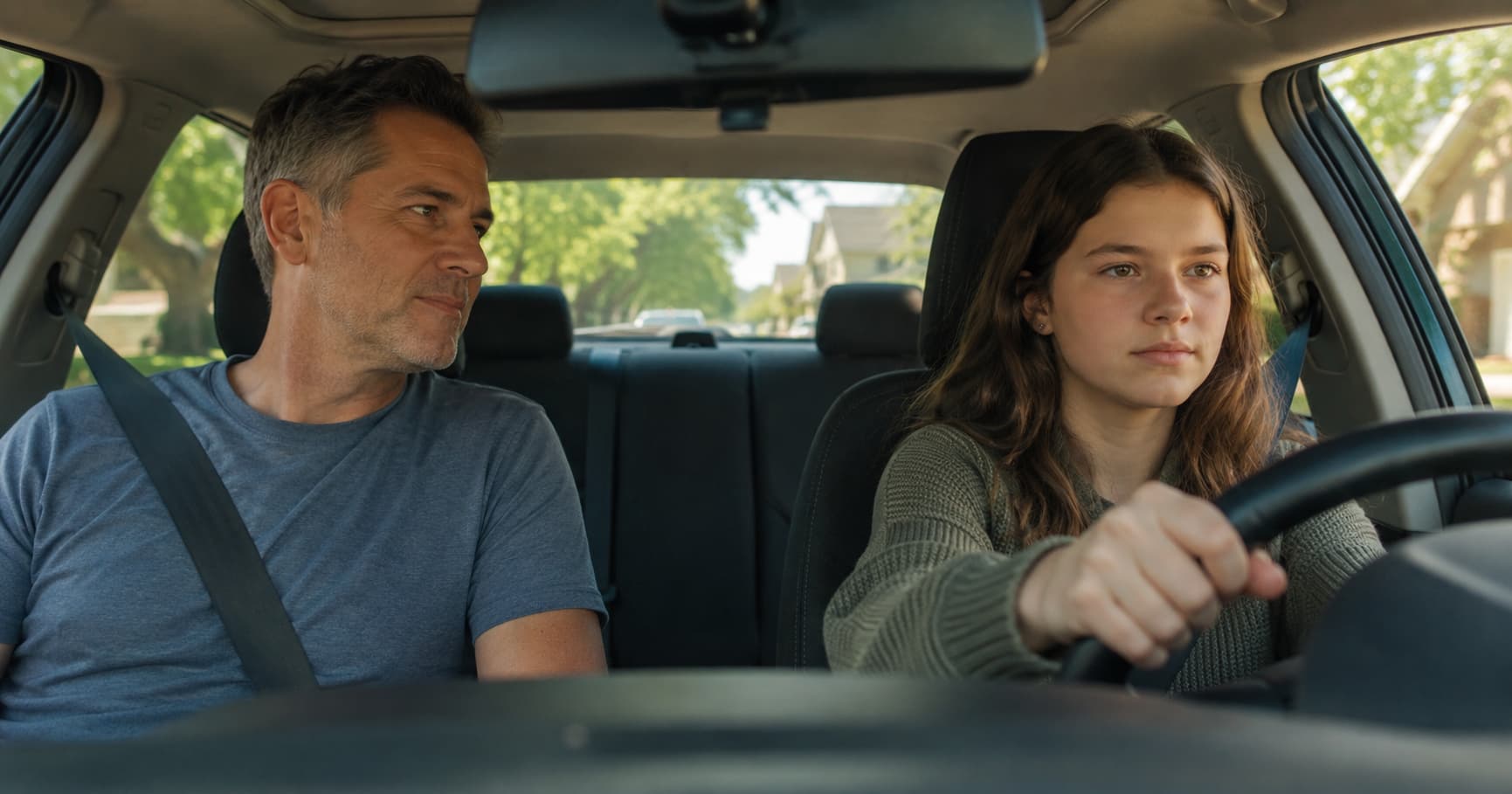
You've survived the white-knuckle merges, the rolling stops, the turns a little too wide. You've been there for all of it — coaching, correcting, telling yourself they're getting there. But "getting there" and ready to drive independently are two different things. Teen smart driving isn't just about practice — it's about building the right skills. And most parents aren't sure exactly when one becomes the other.
It's an honest question that most families never fully resolve. When the time comes to hand over the keys, the decision usually comes down to a feeling — "she seems confident," "he's driven a lot," "they passed the behind the wheel test months ago." Those things matter. But confidence isn't competence, and hours aren't skills.
Hours in the car don't automatically build safe habits. Teen driving statistics consistently show that crash risk is highest in the first months of independent driving — not because teens haven't practiced, but because practice alone doesn't guarantee the right skills are developing. Research shows teens can accumulate weeks of supervised driving and still make the same critical errors that cause crashes. Logging time is necessary. But it isn't enough.
What actually reduces risk is deliberate, feedback-driven practice across a specific set of behaviors — the ones that decades of crash research have identified as the real difference between a teen who's been in a car a lot and a teen who's genuinely ready to drive independently.
There are seven of them. And as a parent, you can observe and track every single one from the passenger seat. That's where this guide starts.
Why Hours Logged Don't Tell the Whole Story
Most U.S. states require supervised driving hours before a teen can get a license. The requirement exists for good reason — experience matters. But the research behind teen driving safety tells a more complicated story.
Studies from the Children's Hospital of Philadelphia found that the amount of supervised practice was only weakly associated with reductions in critical driving errors. In other words, teens who logged more hours weren't automatically making fewer dangerous mistakes. What made the difference was what happened during those hours — whether specific skills were being actively observed, discussed, and developed.
This is the gap most families hit. There's no shortage of teen driving apps to track hours or log sessions. What's been missing is a structured way to evaluate whether the skills that actually matter are improving. That's the problem the Drive Readiness Score™ (DRS) — developed by the team at Drivvy — was built to solve.
The DRS is a research-informed framework built around seven behavioral dimensions. After each supervised drive, parents rate their teen across each one. Over time, the scores reveal which skills are developing, which are plateauing, and which still need focused practice. If you want to go deep on the research behind the framework, the full science is covered in The Science Behind the Drive Readiness Score™ — a detailed breakdown of the crash data and peer-reviewed studies that shaped each pillar.
For now, here's what each of the seven skills means — and why it matters.
The 7 Skills Every Parent Should Be Tracking
1. Speed Management
Speed management is about more than staying under the speed limit. It's whether your teen consistently chooses a speed that's appropriate for the conditions — traffic flow, weather, visibility, road type — without needing reminders to slow down.
Teen driving statistics show that young drivers lead every other age group in speeding involvement in fatal crashes. Crucially, most of this isn't intentional recklessness. It reflects a genuine skill gap in judging and regulating speed — one that develops through deliberate practice and specific feedback, not just miles driven. When you're in the passenger seat, pay attention to whether your teen is making conscious speed choices or just going with the flow.
2. Hazard Awareness
Hazard awareness is the ability to scan the road actively — checking mirrors and blind spots, noticing pedestrians and cyclists, and identifying potential problems early rather than reacting at the last moment.
Of all the behaviors that separate experienced drivers from novices, this one is most consistently linked to crash risk. Research analyzing thousands of teen crashes found that inadequate visual search was the single largest contributing factor — larger than speeding, larger than distraction. The issue isn't reaction speed. Teens can react quickly when they see a hazard. The problem is that novice drivers often don't look in the right place at the right time. This is a habit that can be taught and practiced, and supervised driving is the best environment to build it.
3. Distraction Control
Distraction control measures whether your teen stays fully focused on the driving task — avoiding phone use, staying mentally engaged, and limiting unnecessary adjustments while behind the wheel.
Distracted driving is one of the most well-documented risk factors for teen crashes. What makes it particularly dangerous for teens is that they face two amplifying sources at once: phones and passengers. Research shows that peer passengers are a significant distraction factor — especially for male teen drivers — and that crash risk rises with each additional teen in the car. A zero-tolerance phone rule from day one, modeled consistently by parents, is one of the most effective habits you can build during the supervised driving period.
4. Space Management
Space management is whether your teen maintains a safe following distance, avoids tailgating, and positions the vehicle appropriately in traffic — leaving enough room and time to react.
Rear-end collisions are the most common crash type on American roads, and teens are significantly over-represented in this pattern. In a CHOP simulation study, 35% of novice teen drivers crashed in a standard braking scenario — while none of the experienced adult drivers did. The difference wasn't reaction speed — it was following distance. Teens were simply too close to the vehicle ahead to have any margin when it braked. The 3-second rule is a concrete, teachable habit: pick a fixed landmark, count after the car ahead passes it, and make sure your teen reaches it after three full seconds. Practice it explicitly until it becomes automatic.
5. Independent Decision-Making
Independent decision-making is whether your teen can make safe, timely decisions on their own — choosing proper gaps when turning or merging, handling intersections, and preparing for maneuvers without needing coaching from the passenger seat.
This is where inexperience shows up most clearly under pressure. Research identifies decision errors — inadequate gap selection, misjudging oncoming traffic speed, unsafe lane changes — as the second largest category of teen driver errors after recognition failures. Intersections are the most demanding environment, and left turns across traffic are among the most cognitively complex tasks in everyday driving. Deliberately practicing these scenarios during supervised drives — unprotected left turns, four-way stops, highway merges — is what builds genuine judgment, not just familiarity.
6. Situational Adaptability
Situational adaptability is whether your teen adjusts their driving appropriately when conditions change — slowing for construction zones, adapting to heavy traffic, responding to poor weather, or creating extra space around unpredictable drivers.
This skill develops through exposure, which means it has a direct practical implication: if your teen's supervised driving has mostly happened in familiar neighborhoods in good weather, there are gaps in their experience that matter. Research from the CDC shows that 44% of teen crash deaths occur between 9 PM and 6 AM, despite teens driving relatively few miles at night. Adverse weather and unfamiliar roads also significantly increase crash risk for novice drivers. The goal of supervised practice should be to deliberately broaden conditions — not to avoid challenging situations, but to make sure your teen encounters them for the first time with you in the car.
7. Emotional Regulation
Emotional regulation is whether your teen stays calm and in control during stressful situations — a near-miss, an aggressive driver, a mistake at an intersection — without overreacting or letting frustration affect their driving.
This pillar is easy to overlook because it feels less like a driving skill and more like a personality trait. It isn't. Research shows that driving anger measurably degrades vehicle control and decision-making — and that the effects can persist into subsequent drives even after the triggering event has passed. The teen brain processes emotional signals with full intensity but with less consistent capacity to regulate them, which makes this skill worth consciously building. Talking through emotional scenarios before they happen — not just after — is one of the most effective ways to prepare a teen for the real thing.
How to Use These Seven Skills on Your Next Drive
Knowing these seven dimensions is the starting point. Using them consistently is what builds safe habits over time.
After each supervised drive, take a few minutes to think through how your teen performed across each one. Which skills showed up well? Which needed a reminder? Were there moments worth discussing — a close following distance on the highway, a hesitation at an intersection, a moment of frustration with another driver? The goal isn't to grade every drive — it's to make the feedback specific and actionable rather than a general impression of whether it "went well."
Specific feedback is what changes behavior. "Good drive" doesn't give your teen anything to work on. "You were following too closely on the main road — let's practice the 3-second rule on the next one" does. That level of specificity is hard to sustain when you're relying on memory and general impressions alone. A clear framework changes that — it lets you give intentional, targeted feedback after every session and deliberately practice the skills that need the most work, not just react to whatever happened to stand out.
This is exactly what how to teach a teen to drive looks like when it's done well — and how to teach your teen to drive in a way that builds genuine readiness, not just logged hours.
Most parents have already tried a teen driving log app. You tap start, tap stop, the hours add up. It does its job. But it doesn't tell you whether your teen is actually getting better at the skills that matter — and it doesn't give you a structure for figuring that out yourself.
Drivvy is different. Yes, it logs every supervised drive automatically — time, distance, conditions, route — and works as a supervised driving log your teen can export when it's time to apply for a license. But the core of the app is parent engagement: after each session, you rate your teen across all seven skills using the Drive Readiness Score™, a research-informed framework built around the behaviors most linked to teen crash risk. Each skill gets rated on a simple slider from "required active coaching" to "fully independent." Over time, those ratings build into a real picture of your teen's development — which skills are improving, which are plateauing, and exactly where to focus on your next drive. It also makes it easy to monitor teen driving progress across weeks and months, so the decision to let your teen drive independently isn't based on a feeling. It's based on evidence you've collected yourself, one drive at a time.

The Bottom Line
Readiness to drive independently isn't a milestone that arrives automatically with age, a passed test, or a completed driving log. It's built — deliberately, across specific skills, with consistent and honest feedback along the way.
The supervised driving period is one of the most valuable safety tools available to your family. Research consistently shows that teens whose parents remain actively involved — setting clear expectations, observing specific behaviors, and having real conversations about what happened on each drive — have significantly lower crash rates than teens whose parents stepped back once the hours were logged. The difference isn't how much time they spent in the car. It's how that time was used.
Teen smart driving means something more than following the rules. It means your teen has developed the judgment, attention, and emotional steadiness to handle the road when you're no longer in the seat beside them. These seven skills are what that looks like in practice. Start tracking them, and the picture of your teen's readiness gets a lot clearer — and the decision to hand over the keys becomes one you can make with confidence, not just hope.
Want to go deeper on the research behind these seven skills? The Science Behind the Drive Readiness Score™ covers the crash data, peer-reviewed studies, and behavioral research that shaped each pillar — written for parents who want to understand not just what to look for, but why it matters.